Discover the Power of Molecular Biology
Dive into essential insights on DNA structure, replication, and cutting-edge genetic technologies.
Unlocking the Code of Life (DNA & RNA)
Welcome to Chapter 2! In Chapter 1, we looked at the big picture of life. Now, we are zooming in—way in—to the molecular level.
Molecular Biology is the branch of biology that seeks to understand the molecular basis of biological activity. This includes studying how molecules are synthesized, modified, and how they interact. At the center of it all are Nucleic Acids (DNA and RNA), the molecules that carry the instructions for building every living thing.
Today, we cover Chapter 2.1, breaking down the structure of DNA/RNA and the fascinating process of Replication.

DNA Structure and Replication
Understand the intricate double helix design and how DNA faithfully copies itself to transmit genetic information.

Genetic Code and Protein Synthesis
Learn how the genetic code directs protein assembly, driving cellular functions and organism development.

Advanced Genetic Engineering
Explore techniques for creating genetically modified organisms and animals, revolutionizing research and biotechnology.
Dive Into Molecular Biology
Discover foundational concepts and cutting-edge techniques that illuminate the fascinating world of molecular biology.
DNA Structure & Replication
Understand the double helix and how genetic information is copied with precision.
1. The Structure of DNA
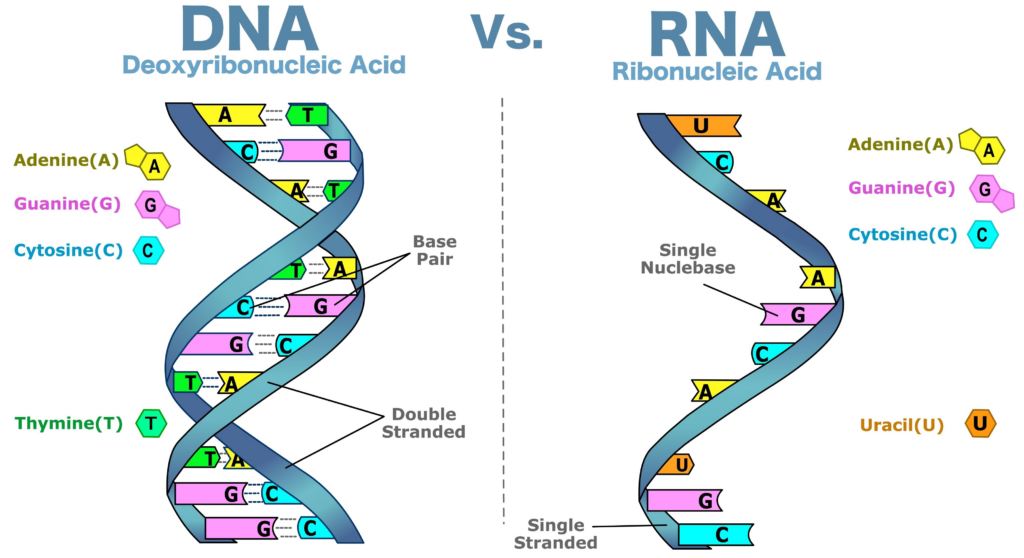
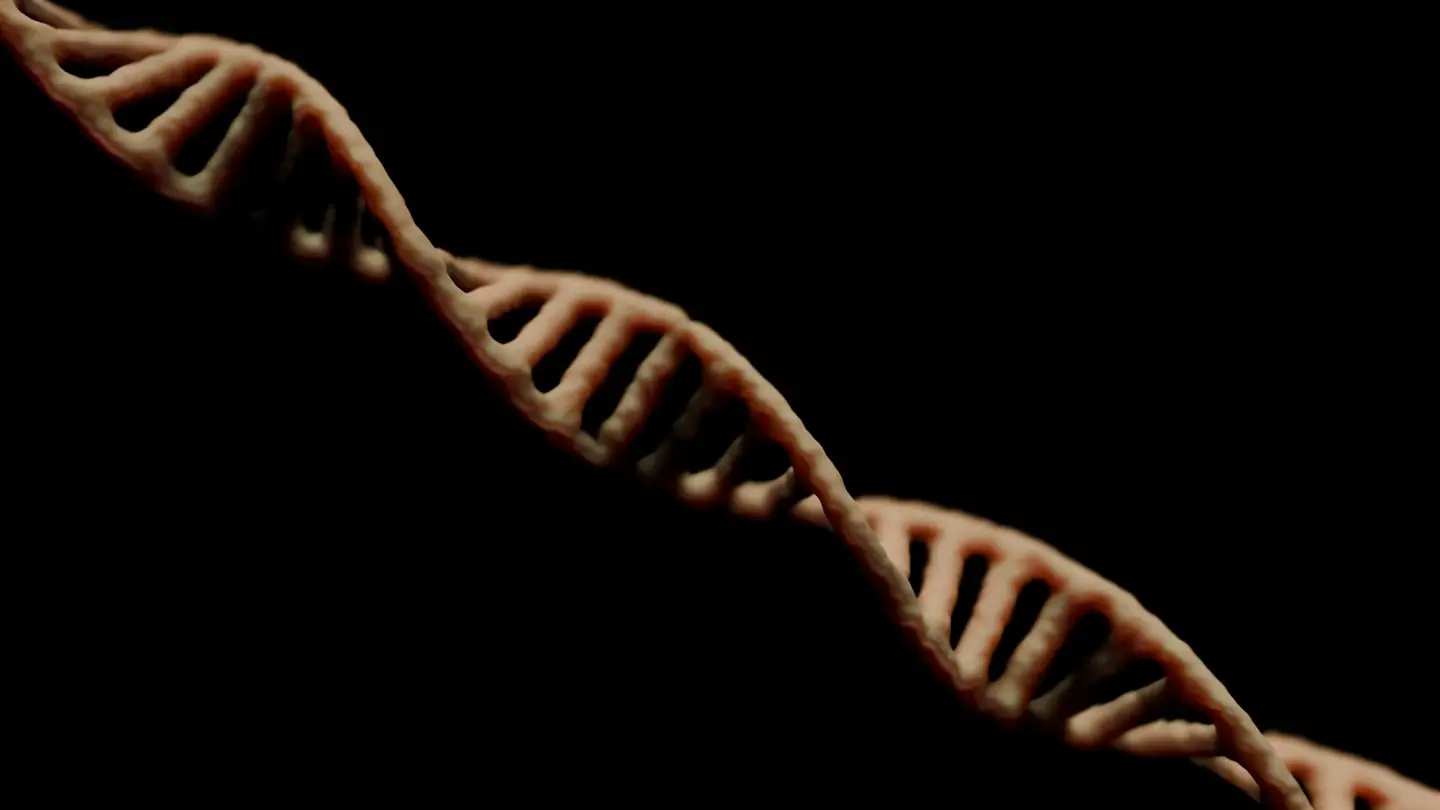
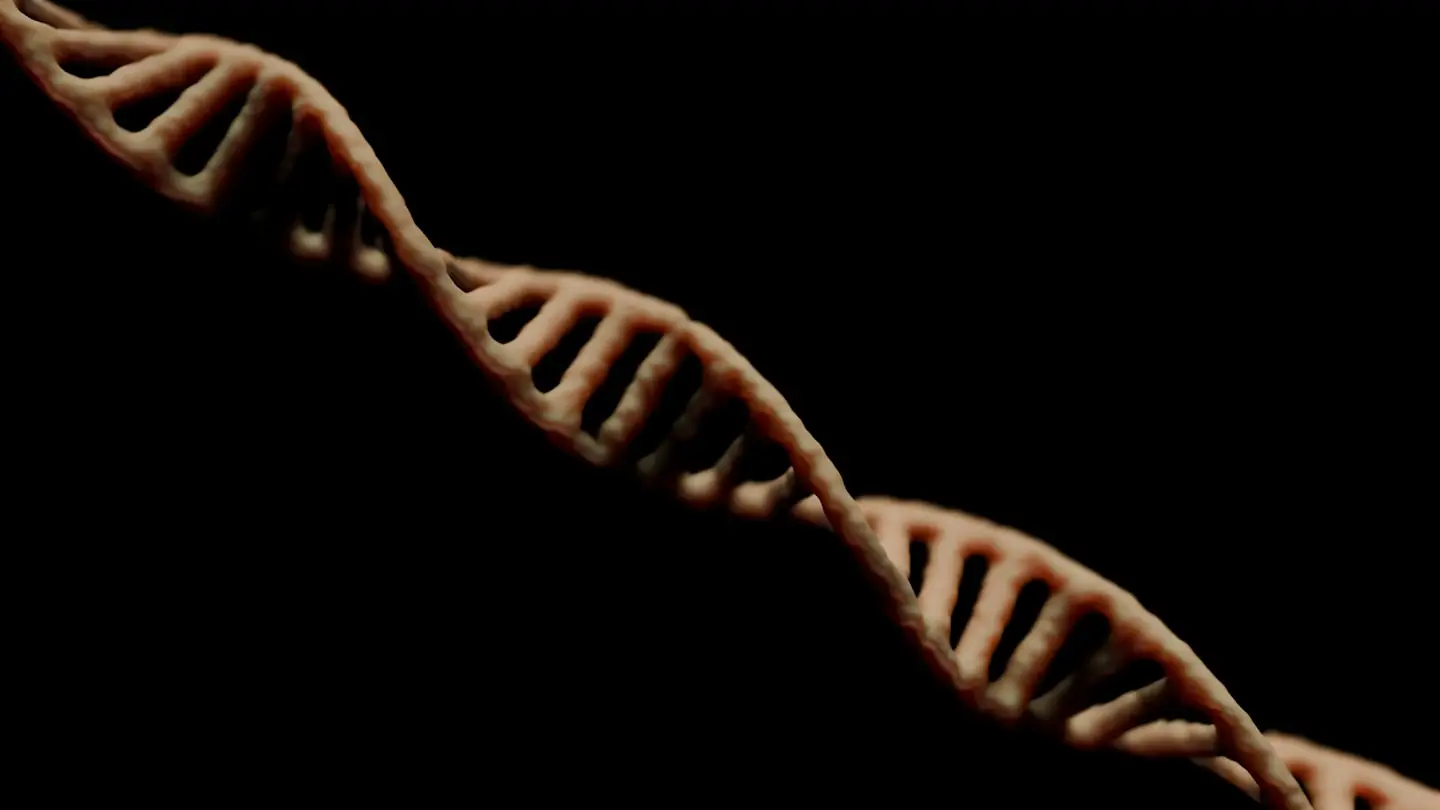
DNA (Deoxyribonucleic Acid) is the master blueprint for life. It consists of two strands twisted around each other in a double helix shape.
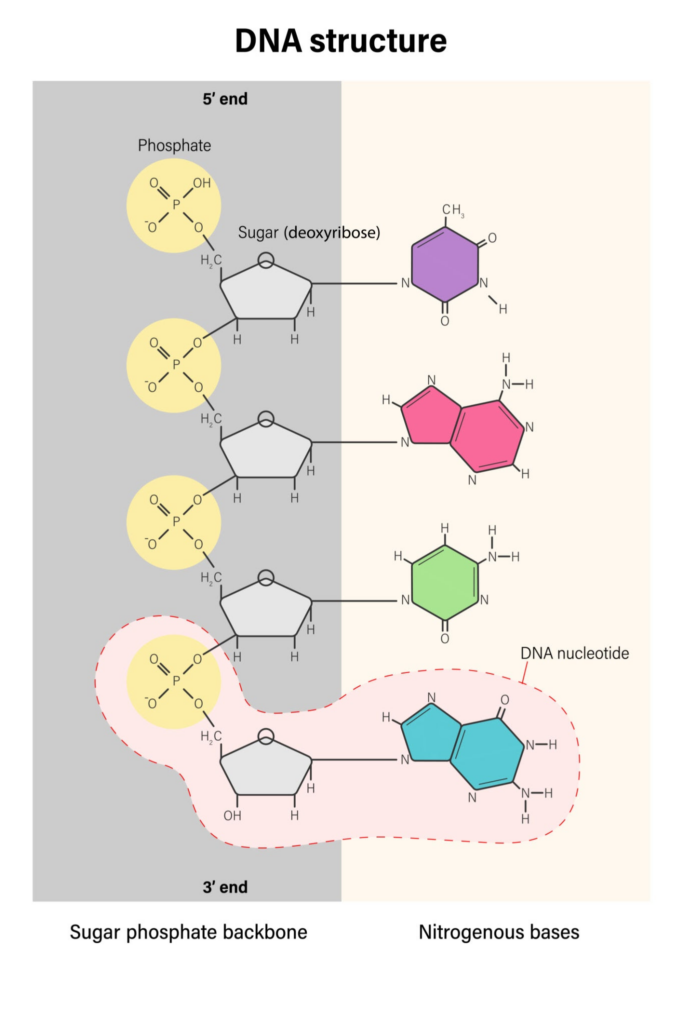
The Building Blocks: Nucleotides Each strand of DNA is a polymer made of many repeating units called nucleotides. A single nucleotide has three parts:
- A five-carbon sugar called deoxyribose.
- A phosphate group.
- A nitrogen-containing base.
The Bases The nitrogenous bases come in two types:
- Purines: Adenine (A) and Guanine (G) (double-ring structure).
- Pyrimidines: Cytosine (C) and Thymine (T) (single-ring structure).
Complementary Base Pairing The two strands are held together by hydrogen bonds between the bases. They pair up in a very specific way:
- A always pairs with T (held by 2 hydrogen bonds).
- C always pairs with G (held by 3 hydrogen bonds).
Antiparallel Strands The two strands of DNA run in opposite directions, like a two-way street. We call this antiparallel.
- One strand runs 5′ to 3′.
- The other runs 3′ to 5′.
- Note: The 5′ end has a phosphate group, and the 3′ end has an OH group.
2. The Structure of RNA
RNA (Ribonucleic Acid) is similar to DNA but has a few key differences. It acts as the worker that carries out DNA’s instructions.
Key Differences from DNA:
- Sugar: It uses ribose instead of deoxyribose.
- Strands: It is single-stranded (though tRNA can fold back on itself).
- Bases: It contains Uracil (U) instead of Thymine (T). So, in RNA, A pairs with U.
Types of RNA: There are three main types involved in making proteins:
- mRNA (Messenger RNA): Acts as the template for translation.
- tRNA (Transfer RNA): Carries specific amino acids to the ribosome.
- rRNA (Ribosomal RNA): Reads the codon on mRNA.
Genetic Code & Protein Synthesis
Explore how DNA instructions are translated into vital proteins that sustain life.
Cracking the Code & Building Proteins
Welcome back to BioLearn Hub! In our last lesson, we learned that DNA holds the instructions for life. But how does a string of chemicals actually build a muscle, an enzyme, or a hormone?
Today, we are covering Chapter 2.2 (The Genetic Code) and 2.3 (Protein Synthesis). This is the incredible process where your cells act like translators and construction workers, turning genetic information into physical reality.
1. The Genetic Code: The Language of Life
DNA uses a specific set of rules called the Genetic Code to translate information into proteins.
The code connects two different languages:
- The Nucleotide sequence of DNA/mRNA.
- The Amino acid sequence of a protein.
The Triplet Code (Codon)
Proteins are built from 20 different amino acids, but DNA only has 4 bases (A, U, G, C in RNA).
- If 1 base coded for 1 amino acid, we’d only have 4 amino acids.
- If 2 bases coded for 1 amino acid ($4 times 4$), we’d have 16.
- Therefore, nature uses 3 nucleotides to form a code. This is called a Triplet Code or a Codon1.
- This gives $4 times 4 times 4 = 64$ possible combinations, which is more than enough for the 20 amino acids2.
Key Signals in the Code:
- Start Codon (AUG): This signals the start of protein synthesis and codes for the amino acid methionine3.
- Stop Codons (UAA, UAG, UGA): These act like a “period” at the end of a sentence. They stop the process4.
2. Important Characteristics of the Genetic Code
The genetic code is robust and precise. It has three major features you need to remember:
- Redundant: Since there are 64 codons but only 20 amino acids, more than one codon can code for the same amino acid5. This provides a buffer against some mutations.
- Continuous: The code is read as a continuous series of three-letter words without spaces, punctuation, or overlap6. Knowing exactly where to start is crucial!
- Nearly Universal: Almost every organism on Earth—from bacteria to humans—uses this exact same code7. This is powerful evidence that all life shares a common evolutionary origin.
3. Protein Synthesis: From DNA to Protein
This process follows the “Central Dogma” of biology:
DNA $rightarrow$ RNA $rightarrow$ Protein 8
It happens in two main stages: Transcription (rewriting the code) and Translation (decoding the code).
Stage 1: Transcription (In the Nucleus)
This is the process of copying a segment of DNA into mRNA. It has three phases9:
- Initiation: Only one strand of the DNA (the antisense or template strand) is used10. The other strand is ignored.
- Elongation: An enzyme called RNA Polymerase moves along the DNA, building a strand of mRNA. It adds nucleotides that are complementary to the DNA template (A pairs with U, C pairs with G)11.
- Termination: When the RNA Polymerase hits a specific “termination signal,” it detaches, and the new mRNA strand is released12.
(Note: Before leaving the nucleus, this pre-mRNA is modified—getting a cap and a tail—and “spliced” to remove non-coding regions called introns13.)
Stage 2: Translation (In the Cytoplasm)
Now, the mRNA travels to a ribosome to get built into a protein. This requires tRNA (Transfer RNA), which acts as the physical link. Each tRNA has an anticodon on one end (to match the mRNA) and carries a specific amino acid on the other14.
Genetic Engineering Applications
Learn about creating genetically modified organisms and animals using advanced molecular techniques.
Editing the Code of Life (Genetic Engineering)
Welcome back to BioLearn Hub! We have learned how DNA works naturally. Now, we are going to look at how scientists can actually manipulate that code to solve problems. This is the field of Molecular Genetics.
Today, we are covering Chapter 2.4: Some Techniques in Molecular Biology. We will explore how we create Genetically Modified Organisms (GMOs), from glowing bacteria to vitamin-enriched rice and medicine-producing sheep.
1. Production of Genetically Engineered Organisms
Genetic engineering is the alteration of an organism’s genetic material in a specific manner. When we take a gene from one species and put it into another, the result is often called a Genetically Modified Organism (GMO) or a Transgenic organism.
- Transgenic: Describes an organism that is produced from the introduction of foreign DNA into its genome, providing it with a new phenotype (physical trait).
- The techniques used to do this rely on Recombinant DNA technology.
2. Recombinant DNA: The “Cut and Paste” Tool
Recombinant DNA is the method of transferring a gene from one organism into the genome of another organism of a different species.
To do this, you need a delivery vehicle called a vector. Vectors can be:
- Plasmids (circular DNA from bacteria).
- Harmless viruses.
- Liposomes.
- Gene guns.
How it works (The Process):
- Isolation: The desired gene is identified in a donor organism.
- Cutting: Both the donor DNA and the plasmid vector are cut using restriction enzymes.
- Joining: The cut gene is inserted into the cut plasmid. They are glued together by an enzyme called DNA ligase.
- Result: You now have a piece of Recombinant DNA ready to be put into a new host cell.
Explore Molecular Biology Insights
Delve into comprehensive materials that unravel the fundamentals and innovations in molecular biology.
DNA Structure & Replication
Understand the intricate architecture of DNA and the mechanisms behind its duplication.
3. The Role of DNA
DNA is the hereditary material responsible for passing genetic information from parent to offspring20. A typical mammalian cell has about 3.2 billion base pairs!21.
Why is DNA so good at its job?
- Stability: It is a stable structure that rarely mutates, ensuring info is passed accurately22.
- Replication: The hydrogen bonds allow the strands to separate easily for copying23.
- Capacity: Being a large molecule, it carries a massive amount of genetic info24.
- Protection: The genetic data (bases) are protected inside the sugar-phosphate backbone25.
4. DNA Replication: Copying the Code
Before a cell divides, it must copy its DNA. This process is Semiconservative, meaning each new DNA molecule consists of one old (parental) strand and one new strand26.
The Steps of Replication:
Step 1: Unwinding
- Helicase enzymes unwind the double helix and unzip the hydrogen bonds27.
- Topoisomerase helps relieve the tension caused by unwinding28.
- Single-stranded binding proteins hold the strands apart so they don’t snap back together29.
- This creates a “Replication Bubble” with a Y-shaped region called a replication fork30.
Step 2: Priming
- DNA Polymerase III (the builder) cannot start from scratch; it needs a starter.
- An enzyme called Primase makes a short RNA primer to get things started31.
Step 3: Elongation (Building)
- DNA Polymerase III adds new nucleotides to the chain.
- Crucial Rule: It can only add nucleotides in the 5′ to 3′ direction32.
- Leading Strand: Synthesized continuously toward the replication fork33.
- Lagging Strand: Synthesized in short chunks (away from the fork) called Okazaki fragments34.
- DNA Ligase eventually joins these fragments together into a continuous strand35.
Step 4: Proofreading
- DNA Polymerase I acts as a proofreader, replacing the RNA primers with DNA and fixing mismatched bases36.
🧠 Summary Table: Enzymes in Replication
| Enzyme | Function |
| Helicase | Unwinds the parental double helix37. |
| Primase | Synthesizes an RNA primer to start the chain38. |
| DNA Pol III | Adds new nucleotides to synthesize the new strand39. |
| DNA Pol I | Removes RNA primer and replaces it with DNA40. |
| Ligase | Joins Okazaki fragments together41. |
That’s it for today!
You now understand the blueprint of life and how it copies itself. Next time, we will learn how this code is read to build you—a process called Protein Synthesis.
Suggested Activity: Draw a replication fork and label the Leading Strand, Lagging Strand, and Helicase. Seeing it on paper helps the direction (5′ to 3′) make sense!
Genetic Code & Protein Synthesis
Discover how genetic information directs protein formation through the genetic code.
3. Protein Synthesis: From DNA to Protein
This process follows the “Central Dogma” of biology:
DNA $rightarrow$ RNA $rightarrow$ Protein 8
It happens in two main stages: Transcription (rewriting the code) and Translation (decoding the code).
Stage 1: Transcription (In the Nucleus)
This is the process of copying a segment of DNA into mRNA. It has three phases9:
- Initiation: Only one strand of the DNA (the antisense or template strand) is used10. The other strand is ignored.
- Elongation: An enzyme called RNA Polymerase moves along the DNA, building a strand of mRNA. It adds nucleotides that are complementary to the DNA template (A pairs with U, C pairs with G)11.
- Termination: When the RNA Polymerase hits a specific “termination signal,” it detaches, and the new mRNA strand is released12.
(Note: Before leaving the nucleus, this pre-mRNA is modified—getting a cap and a tail—and “spliced” to remove non-coding regions called introns13.)
Stage 2: Translation (In the Cytoplasm)
Now, the mRNA travels to a ribosome to get built into a protein. This requires tRNA (Transfer RNA), which acts as the physical link. Each tRNA has an anticodon on one end (to match the mRNA) and carries a specific amino acid on the other14.
Shutterstock
The Three Steps of Translation:
1. Initiation
- The small ribosomal subunit binds to the mRNA near the Start Codon (AUG)15.
- An initiator tRNA (carrying Methionine) with the anticodon UAC pairs with the start codon16.
- The large ribosomal subunit joins to complete the assembly17.
2. Elongation
- The ribosome has specific slots (A site, P site, E site).
- A new tRNA carrying an amino acid enters the A site18.
- A peptide bond forms between the new amino acid and the growing chain19.
- The ribosome moves forward (translocation), pushing the empty tRNA to the exit20.
- This cycle repeats, adding amino acids one by one.
3. Termination
- This happens when a Stop Codon (UAA, UAG, or UGA) reaches the ribosome’s A site21.
- Instead of a tRNA, a release factor binds to the stop codon22.
- This cuts the bond, releasing the completed polypeptide chain (protein), which folds into its functional shape23.
🧠 Quick Summary
- Genetic Code: A triplet system (codons) that is redundant, continuous, and universal.
- Transcription: DNA is copied into mRNA in the nucleus.
- Translation: Ribosomes and tRNA decode the mRNA to build protein chains in the cytoplasm.
That’s it for today!
You now understand how your body builds itself from the ground up.
Suggested Activity: Write down the DNA sequence TAC GGC TTA.
- Transcribe it to mRNA (Remember A$rightarrow$U!).
- Use the Genetic Code table to translate it into amino acids.
Genetic Engineering Techniques
Investigate cutting-edge methods for creating genetically modified organisms and animals.
3. Golden Rice: Saving Sight with Science
One of the most famous examples of this technology is Golden Rice. Rice is a staple food for millions, but it lacks Vitamin A. Vitamin A deficiency can cause blindness and immune deficiency syndromes, leading to mortality in children.
The Solution: Scientists engineered rice to contain beta-carotene, the orange pigment found in carrots, which our bodies convert into Vitamin A.
How it was made:
- Genes that produce beta-carotene were taken from daffodils and a bacterium called Erwinia.
- These genes were inserted into plasmids and then into Agrobacterium.
- The bacteria infected rice embryos, transferring the beta-carotene genes into the rice genome.
- Result: The rice grains now have a golden color and provide essential Vitamin A.
Other Benefits of GM Crops: Besides nutrition, crops are also engineered for increased yield, heat/drought tolerance, pest resistance, and reduced pesticide use.
4. Genetically Modified Animals: “Pharming”
It is much harder to engineer animals than plants, but it is possible. The Process:
- A foreign gene is inserted into an animal oocyte (egg cell).
- The egg is fertilized and implanted into a host female.
- The resulting offspring are transgenic (they carry the new gene).
This has been done with fish, pigs, cows, rabbits, and sheep.
Why do we do it?
- Pharmaceuticals (Pharming): We can use animals to produce human medicines. For example, a recombinant plasmid containing a human gene can be inserted into a sheep or goat. The animal then produces human proteins (like clotting factors or antibodies) in its milk, which can be harvested and purified to treat diseases like hemophilia.
- Agriculture: To increase milk yield in cows or muscle mass (meat) in livestock.
- Disease Resistance: To make livestock resistant to infections.
- Xenotransplantation: Growing organs in animals that can be transplanted into humans.
🧠 Quick Summary
- Genetic Engineering: Modifying DNA to create new traits.
- Recombinant DNA: Combining DNA from two different species using vectors (plasmids) and enzymes (restriction enzymes, ligase).
- Golden Rice: Transgenic rice containing daffodil genes to prevent Vitamin A deficiency.
- GM Animals: Used to produce medicine in milk, improve food production, or provide organs for transplant.
This concludes Chapter 2! You have now mastered the basics of Molecular Biology. Next, we will move on to the systems that keep organisms moving and alive in Chapter 3: Transport Systems.
Suggested Activity: Research “Insulin production.” Did you know that the insulin diabetics use today is made by genetically modified bacteria using the exact recombinant DNA steps we learned today?
Dive into Molecular Biology Insights
Discover detailed visuals illustrating DNA structure, replication, and genetic engineering techniques.
Molecular Biology Insights
Explore the fundamentals of molecular biology, from DNA structure to cutting-edge genetic engineering techniques.

Step One: DNA Structure and Replication
Understand the molecular architecture of DNA and the mechanisms by which it replicates to ensure genetic fidelity.

Step Two: Genetic Code and Protein Synthesis
Learn how the genetic code directs protein production through transcription and translation processes.

Step Three: Advanced Genetic Engineering
Discover how genetically modified organisms and animals are created using modern biotechnological methods.